In a world where yesterday’s science fiction is today’s headline, the tech landscape is evolving faster than ever. From clunky industrial arms assembling cars in the 20th century to sleek humanoid robots folding laundry at home, and from simple smart thermostats to entire cities wired for efficiency, technology isn’t just advancing—it’s revolutionizing how we live, work, and connect. As we hit October 2025, the fusion of robotics and the Internet of Things (IoT) is propelling us into an era of unprecedented innovation. This article dives into the journey from robotic pioneers to IoT ecosystems, exploring their intersection and what lies ahead.
The Evolution of Robotics: From Sci-Fi to Reality
Robotics has come a long way since the term was coined in 1920 by Karel Čapek in his play R.U.R.. What started as mechanical marvels in factories has blossomed into intelligent companions capable of learning, adapting, and even empathizing. Today, robots aren’t just tools; they’re partners in progress.
Key Advancements in 2025
This year has been a banner one for robotics, with artificial intelligence (AI) taking center stage. Trends like physical AI—where robots interact seamlessly with the real world—analytical AI for decision-making, and generative AI for creative problem-solving are dominating the scene. Humanoid robots, in particular, are stealing the spotlight. Tesla’s Optimus Gen 2 can now handle delicate tasks like sorting objects with human-like precision, while Boston Dynamics’ Electric Atlas is flipping and jumping like an Olympic gymnast.
Collaborative robots, or cobots, are another game-changer, working shoulder-to-shoulder with humans in sectors like healthcare and manufacturing without the need for safety cages. Sustainability is also key, with energy-efficient designs reducing the carbon footprint of these machines. Imagine robots powered by recycled materials patrolling warehouses, optimizing routes to cut energy use by up to 30%—that’s the green robotics wave of 2025.
The Rise of the Internet of Things (IoT): Connecting Everything
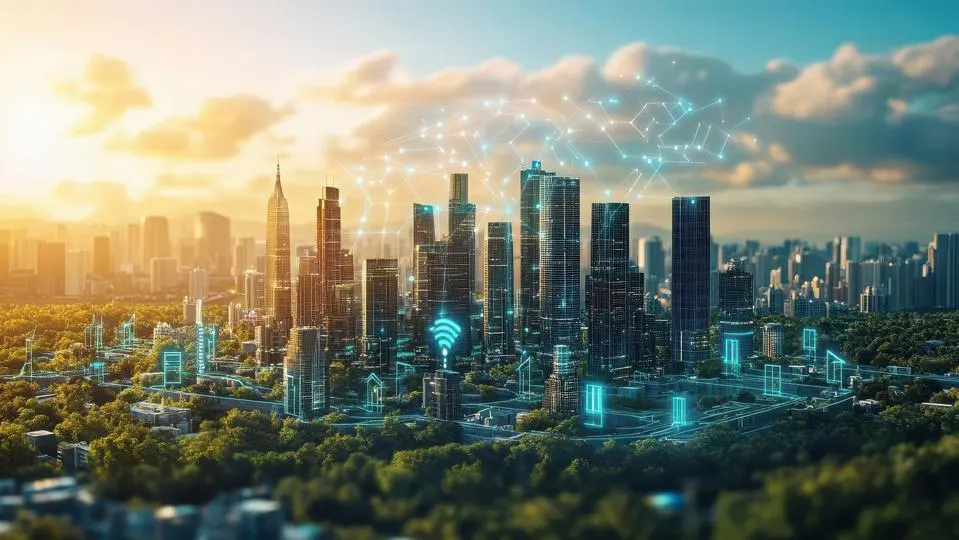
If robotics is about building intelligent machines, IoT is the invisible web that makes them smarter by connecting billions of devices. By 2025, we’re talking over 75 billion connected gadgets worldwide, turning everyday objects into data powerhouses.
Major Trends Shaping IoT in 2025
AIoT—the marriage of AI and IoT—is leading the charge, enabling devices to not just collect data but predict and act on it in real-time. Edge computing is another powerhouse trend, processing data closer to the source to slash latency and boost security—perfect for autonomous vehicles dodging traffic jams on the fly.
5G and emerging 6G networks are supercharging connectivity, allowing for ultra-low latency in everything from remote surgeries to smart factories. Cybersecurity remains a hot button, with built-in encryption and AI-driven threat detection becoming standard to fend off hacks in this hyper-connected world. On the consumer side, emotion-aware devices that adjust lighting or music based on your mood via voice assistants are making homes feel truly intuitive. And let’s not forget sustainability: IoT sensors monitoring energy use in buildings could save industries billions while curbing emissions.
Bridging Worlds: Robotics and IoT Convergence
The real magic happens at the crossroads. Enter IoRT (Internet of Robotics Things), where robots tap into IoT networks for real-time insights, creating swarms of smart, interconnected machines. This isn’t just theory—it’s transforming industries.
Real-World Applications
In manufacturing, cobots equipped with IoT sensors predict maintenance needs before breakdowns occur, boosting uptime by 40%. Logistics? Autonomous drones and robots in warehouses like Amazon’s use IoT for inventory tracking, navigating via 5G for lightning-fast deliveries. Healthcare sees robotic assistants monitoring patients through wearable IoT devices, alerting doctors to anomalies in vital signs. Even agriculture benefits, with IoT-connected robots planting seeds precisely based on soil data, optimizing yields in climate-challenged farms.
Digital twins—virtual replicas of physical robots updated via IoT—allow for safe testing of scenarios, from disaster response to space exploration. The result? Enhanced autonomy, where robots don’t just react but anticipate, making human oversight minimal.
Challenges on the Horizon
No revolution is without hurdles. Privacy concerns loom large as IoT devices hoover up personal data, demanding robust regulations like the EU’s updated GDPR. Job displacement from automated systems sparks debates on reskilling workforces, while ethical dilemmas around AI biases in robots call for diverse development teams. Sustainability efforts must scale too—recycling e-waste from billions of devices is no small feat. Yet, with collaborative approaches, these challenges can fuel even greater innovation.
Looking Ahead: The Future of Tech Integration
By 2030, expect humanoid robots in every home, orchestrated by IoT ecosystems that learn your routines better than you do. Quantum computing could supercharge AIoT for unbreakable security, and bio-inspired robots—mimicking insect swarms—might tackle environmental cleanups. The tech revolution isn’t slowing; it’s accelerating, promising a world that’s smarter, greener, and more equitable—if we steer it right.
FAQs
What is the biggest trend in robotics for 2025?
AI integration, especially in humanoids and cobots, is topping the list, enabling robots to handle complex, adaptive tasks with minimal human input.
How does IoT enhance robotics?
IoT provides real-time data streams that allow robots to make informed decisions, predict issues, and collaborate in networks, leading to smarter automation.
Are there privacy risks with IoT and robotics?
Yes, the vast data collection can lead to breaches, but trends like edge computing and advanced encryption are mitigating these in 2025.
Which industry benefits most from robotics-IoT convergence?
Manufacturing leads, with predictive maintenance and efficient supply chains, but healthcare and logistics are close behind for life-saving and speed gains.
What’s next after 2025 for these technologies?
Look for widespread adoption of 6G-enabled swarms and ethical AI frameworks to ensure inclusive growth across sectors.